Itinerary of one / two day - about 2 hours from Rome and one hour and a half from the main city of Tuscany - and it touches the steps of:
- Volterra (A)
- San Gimignano (B)
- Certaldo (C)
View Larger Map
Volterra
Recommended: Yes
Difficulty: Easy
The city, famous for the extraction and processing of alabaster (beautiful as the expensive shops making direct sales), has a great center of Etruscan origin with Roman ruins and medieval buildings like the Cathedral and the Palazzo dei Priori on the homonymous Square, the nerve center of town.
Of particular interest is
- the Duomo: Romanesque style, was erected in stages between the twelfth and thirteenth century. The interior, restored in the nineteenth century, has anything in the late Renaissance. The bell tower that stands at the side of the facade is an elegant century construction)
- the Baptistery of St. John built in the second half of the thirteenth century, has an octagonal plan with walls decorated in the classic two-tone green and white marble of the typical construction Romanesque. The building is topped by a cupola.
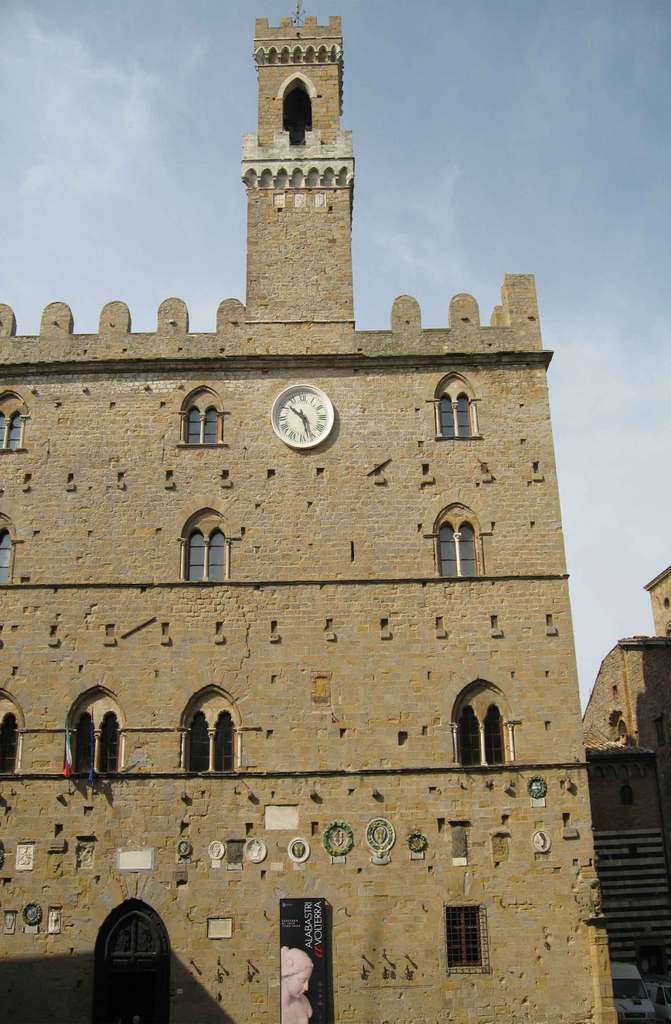
- the Palazzo dei Priori: is located in Piazza dei Priori, and was built in 1246, in the nineteenth century it was modified by the addition of a crown at the top of the tower. Inside, the Grand Council, decorations and badges you can admire the nineteenth century.
- the Walls: of Etruscan origin, was amended in medieval times. Here is the famous Arc Gate, once part of the ancient walls of the fifth century BC
- the Medici Fortress: consists of two forts linked by a curtain wall. The oldest rocks present a semi-elliptical-shaped tower, while the so-called New Fortress, featuring a mighty tower, was built by the will of Lorenzo de 'Medici.
- The Roman Amphitheatre: it was brought to light in the fifties from archaeological excavations in the town of Vallebuona. The monument dates from the late first century BC and its construction was financed by the wealthy family of Volterra Caecina. The theater was partially excavated in the natural slope of an elevation, in analogy to the Greek theater. At the end of the third century, the theater was abandoned in the vicinity of the stage was installed a thermal plant. In the medieval city walls encompass the closing wall of the upper part of the steps (summa auditorium). (Source Wikipedia)
Council to visit the town:
- if possible at a time when there is the historical pageant "Volterra AD 1398, one of the most beautiful I've ever seen, usually in late August.
- before his points are shown from the movie "New Moon" (sequel of "Twilight") in order to boast to friends that he had been in places where it was shot on film! :)


San Gimignano
Recommended: Absolutely
Difficulty: Easy
For the characteristic architecture of the medieval old town is a UNESCO World Heritage Site. The site of San Gimignano, despite some reversals eight-twentieth century, is mostly intact in appearance two-fourteenth century and is one of the best examples in Europe of urban organization of the communal.
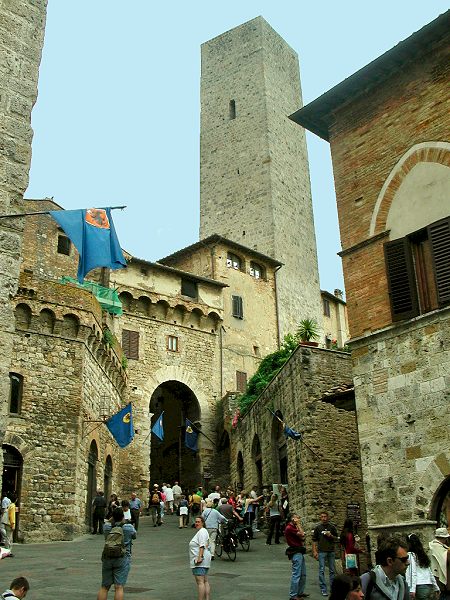
San Gimignano is especially known for about sixteen medieval towers that still stand out on its landscape, which have earned him the nickname of Manhattan of the Middle Ages. Between the 72 towers and tower houses existing in the heyday of the City, it remained twenty-five in 1580 and today there are about fourteen officers, with other decapitate glimpse into the urban fabric. The oldest is the Torre del Podestà, called the Rognosa, which is 51 meters high, while the higher the Torre Grossa, of 54 meters. A regulation of 1255 forbade private citizens to build the tallest towers of Rognosa, even though the two most important families, Ardinghelli and Salvucci, not respected. (Source Wikipedia) San Gimignano
Define 'hidden' is probably heresy, in the sense that is surely to be counted among the medieval villages of Tuscany's most famous and popular, is that some call it the 'pearl' is an understatement for its beauty and poetry.
Do not miss the details and provided 'Museum of Torture' eye as you enter not to fall into the clutches of the Executioner! (Ah:))
For the characteristic architecture of the medieval old town is a UNESCO World Heritage Site. The site of San Gimignano, despite some reversals eight-twentieth century, is mostly intact in appearance two-fourteenth century and is one of the best examples in Europe of urban organization of the communal.
San Gimignano is especially known for about sixteen medieval towers that still stand out on its landscape, which have earned him the nickname of Manhattan of the Middle Ages. Between the 72 towers and tower houses existing in the heyday of the City, it remained twenty-five in 1580 and today there are about fourteen officers, with other decapitate glimpse into the urban fabric. The oldest is the Torre del Podestà, called the Rognosa, which is 51 meters high, while the higher the Torre Grossa, of 54 meters. A regulation of 1255 forbade private citizens to build the tallest towers of Rognosa, even though the two most important families, Ardinghelli and Salvucci, not respected. (Source Wikipedia) San Gimignano
Define 'hidden' is probably heresy, in the sense that is surely to be counted among the medieval villages of Tuscany's most famous and popular, is that some call it the 'pearl' is an understatement for its beauty and poetry.
Do not miss the details and provided 'Museum of Torture' eye as you enter not to fall into the clutches of the Executioner! (Ah:))


Certaldo
Recommended: Yes
Difficulty: Easy
The most interesting part of the town is definitely Certaldo Alto. The main feature of art and architecture of Certaldo Alto, which has made it known and famous in Europe, is the perfectly preserved medieval urban fabric with its narrow streets and small squares here and there, if we exclude the work of restructuring that took as its object the Praetorian Palace in the fifteenth century (the work that transformed the old tower in the palace vicar), we can say that Certaldo Alto has remained the same as how it has developed in the Middle Ages.
Further evidence of this feature is the lack of a large square in the center, while the Instead we find a long and wide street (Via Boccaccio), who carried out the functions, representing the public place of excellence and high-concept typically medieval. (Source Wikipedia)


The most interesting part of the town is definitely Certaldo Alto. The main feature of art and architecture of Certaldo Alto, which has made it known and famous in Europe, is the perfectly preserved medieval urban fabric with its narrow streets and small squares here and there, if we exclude the work of restructuring that took as its object the Praetorian Palace in the fifteenth century (the work that transformed the old tower in the palace vicar), we can say that Certaldo Alto has remained the same as how it has developed in the Middle Ages.
Further evidence of this feature is the lack of a large square in the center, while the Instead we find a long and wide street (Via Boccaccio), who carried out the functions, representing the public place of excellence and high-concept typically medieval. (Source Wikipedia)


